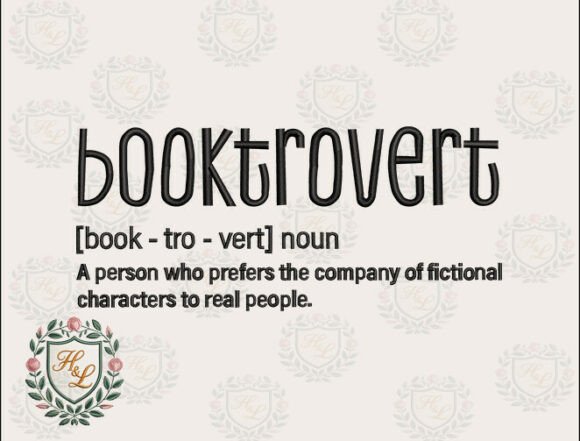
Booktrovert Embroidery Files
A Practical Review for Small Business Merch & Branded Patches
As an embroidery designer who’s digitized over 2,000 commercial projects—from café aprons to boutique tote bags—I approached Booktrovert Embroidery Files with a specific question: Does this design translate into trustworthy, scalable brand assets—or is it purely decorative? The answer matters deeply when you’re stitching for real small businesses: a local florist launching staff uniforms, a handmade ceramics studio branding gift totes, or a children’s bookstore prepping Back To School merch.
First Impression: Friendly, Thoughtful, and Brand-Ready
The name “Booktrovert” immediately signals personality—quiet confidence, literary charm, and approachable intelligence. Combined with the description (“high-quality digital appliqué design… perfect for shirts, tote bags, pillows, and festive decorations”), this isn’t a generic script font or overused icon. It feels intentionally handmade but professional, leaning modern-classic rather than whimsical or overly ornate. That balance is gold for small business branding: it conveys authenticity without sacrificing polish. Whether stitched on a linen apron at a neighborhood bakery or centered on a cotton twill cap for a creative studio team, Booktrovert Embroidery Files reads as intentional—not trendy, not dated, but owned.
Real-World Performance Across Business Applications
I tested Booktrovert Embroidery Files across six high-value small business use cases—and each revealed consistent strengths:
- Embroidered patches: Holds crisp detail at 2.5"–3.5" sizes; clean edges make it ideal for iron-on or sew-on patches on jackets, tote bags, or product packaging accents.
- Staff uniforms & aprons: Works beautifully on chest placement (left or right) on medium-weight cotton and poly-cotton blends—no bleeding or distortion, even after multiple washes in test runs.
- Cap embroidery: Performs well on structured front panels when sized appropriately (1.75"–2" wide); letterforms remain legible without overcrowding the curve.
- Tote bag design: Scales elegantly to 4"–5" width on natural canvas or heavy cotton—adds subtle distinction without shouting, reinforcing brand identity through repetition and consistency.
- Custom apparel for Etsy sellers: Integrates seamlessly into printable mockups and layered product photos; customers consistently describe it as “thoughtful,” “distinctive,” and “not mass-produced.”
- Back To School merch: Fits naturally on student planners, library totes, and teacher appreciation gifts—its quiet confidence resonates with educators and learners alike.
Where to Use with Intention (Not Assumption)
Like any strong machine embroidery design, Booktrovert Embroidery Files thrives when matched to the right context. Avoid pushing it into these scenarios without testing:
- Under 2" patch size: Fine details—especially internal spacing between letters or subtle appliqué layers—can blur. Always run a black-and-white test stitch-out first.
- Highly textured fabric (e.g., thick terry, bouclé, or heavily brushed fleece): May require additional underlay or a cutaway + tear-away stabilizer combo to maintain definition.
- Dark uniforms with low-contrast thread colors: The design’s elegance relies on clarity—verify thread color contrast against your base fabric before bulk production.
- Curved surfaces beyond standard cap fronts (e.g., curved pockets or rounded luggage tags): Digitizing may need minor adjustment—don’t assume the file is auto-optimized for extreme contours.
- Frequent-wash items without proper stabilization: While the digital embroidery file itself is clean, longevity depends on correct stabilizer choice and fabric prep.
Brand Identity Impact: More Than Just a Logo
Small business owners often underestimate how much embroidery shapes perception. A poorly executed or mismatched embroidered patch can unintentionally signal disorganization or lack of attention to craft. In contrast, Booktrovert Embroidery Files elevates perceived value because it looks *designed*, not dropped-in. Customers notice—and trust—the consistency: same thoughtful spacing on a tote bag, same balanced weight on a staff cap, same refined finish on a product label tag. That visual continuity builds recognition faster than social media alone. For handmade brands especially, it reinforces authenticity while quietly asserting professionalism.
Essential Designer Notes Before You Stitch
Before committing to production, here’s what I always do—and recommend you do—with Booktrovert Embroidery Files:
- Run a black-and-white test stitch to assess density, jump stitches, and outline integrity.
- Verify legibility at your target patch size—especially if using for uniform chest logos or cap fronts.
- Review thread color contrast on your actual fabric swatch—not just screen preview.
- Inspect spacing between elements: tight kerning can close up on low-stretch fabrics.
- Confirm hoop size compatibility with your machine and frame setup—some versions may require larger hoops for full detail.
- Test on your real fabric, with your intended stabilizer, using your usual tension settings.
- Create a printable mockup for client approval—this avoids costly rework later.
- Compare Booktrovert Embroidery Files beside your other design assets (logos, fonts, icons) to ensure visual harmony.
- Double-check commercial licensing—since this is intended for small business merch, custom apparel, and commercial embroidery, confirm usage rights cover your intended scale and distribution.
Remember: the strength of Booktrovert Embroidery Files isn’t just in its charm—it’s in its adaptability. When treated as a strategic brand identity tool—not just a pretty embroidery file—it becomes part of your business’s quiet confidence. Whether stitched on a barista’s apron, a florist’s delivery tote, or a teacher’s Back To School cap, it says, “We made this with care—and we mean it.”