Classic Red Apple Embroidery Design Review
First Impression: Timeless, Friendly, and Professionally Approachable
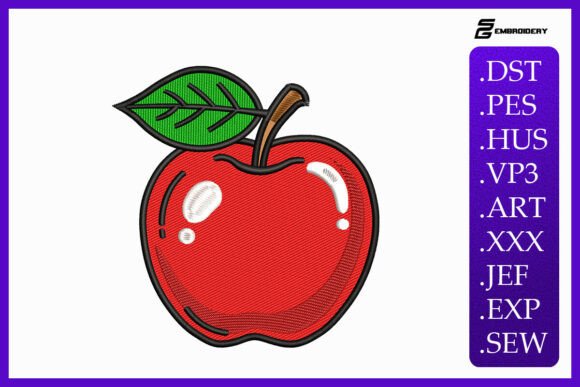
As an embroidery designer who’s developed hundreds of commercial designs for small businesses—from neighborhood bakeries to boutique florists—I immediately recognize the quiet strength in Classic Red Apple. The name alone signals clarity and familiarity. It doesn’t try to be trendy or abstract; it leans into warmth, honesty, and visual accessibility—qualities that build instant trust with customers. This isn’t a decorative flourish for craft projects only. It’s a machine embroidery design built for brand storytelling: friendly enough for a teacher appreciation tote, bold enough for a café apron, and refined enough for a handmade product label.
Real-World Business Use: Where Classic Red Apple Shines
Classic Red Apple excels where small business merch needs both personality and professionalism. On embroidered patches, its clean silhouette holds up beautifully—even at 2.5” height—making it ideal for staff uniforms, boutique gift tags, or sew-on branding on reusable shopping bags. For cap embroidery, it works best centered on the front panel or subtly on the side gusset, especially when paired with a short business name (e.g., “Honeycomb Bakery • Classic Red Apple”). Its balanced proportions avoid distortion on curved surfaces like baseball caps or rolled sleeves.
For custom apparel, Classic Red Apple delivers strong visual consistency across diverse items: stitched on cotton aprons for kitchen studios, scaled down for baby clothes sold at local markets, or enlarged as a focal point on linen tote bag design. Its food-category roots make it a natural fit for cafés, orchards, health-food shops, and farm-to-table brands—but don’t limit it there. Florists use it as a subtle nod to seasonal harvests; pet brands reinterpret it as a playful “treat” motif; even creative studios adopt it as a symbol of fresh ideas and grounded craftsmanship.
In commercial embroidery settings, this design performs reliably across fabric textures—from medium-weight twill to terry cloth kitchen towels—provided proper stabilizer is used. It avoids excessive stitch density, reducing puckering risk on lightweight knits or textured fabrics like canvas or burlap. That means fewer re-runs, faster turnaround, and happier clients reviewing printable mockups before production.
Where to Use Classic Red Apple With Intention
While versatile, Classic Red Apple has practical boundaries. Avoid scaling it below 1.75” for embroidered patch use—fine stem details and smooth curves may lose definition. On dark uniforms or navy caps, verify thread color contrast: a bright red apple against black fabric demands high-saturation thread (like Sulky 40wt or Madeira Polyneon) and possibly a white underlay for pop. If your small business merch includes frequent washing—think staff aprons or daycare tote bags—confirm the design avoids overly tight satin-stitched areas that could fray over time.
Also consider context: on product packaging accents or tiny labels, Classic Red Apple may need simplification (e.g., removing subtle shading or interior leaf veins) unless the file offers multiple versions. And always test it on real fabric—not just software preview—especially for curved or stretchy substrates like ribbed knit caps or elasticized waistbands.
Brand Identity Impact: More Than Just an Apple
Small business owners often underestimate how much a single embroidery file influences perceived value. Classic Red Apple supports brand identity by signaling authenticity, care, and approachability. Unlike generic clip art or overused vector icons, a well-executed machine embroidery design like this tells customers: *We invested in quality, not shortcuts.* That builds recognition across touchpoints—whether it’s stitched on a barista’s apron, heat-applied as a woven label, or featured in an Etsy shop banner.
It also reinforces visual consistency without feeling rigid. You can pair it with serif fonts for a classic bakery aesthetic, or minimalist sans-serifs for a modern wellness studio—all while keeping the core symbol instantly legible. That flexibility helps handmade product lines scale gracefully, whether you’re launching one signature tote or building a full line of branded merchandise.
Practical Designer Notes Before You Stitch
Before committing to bulk production, follow these field-tested steps:
- Test in black and white first—this reveals spacing issues, outline clarity, and overall balance without color distraction.
- Check small-patch viability—load the digital embroidery file into your software and scale to 1.75” and 2”. Look for legibility in the stem, leaf, and apple contour.
- Review thread color contrast—especially if using non-red thread options (e.g., sage green for a botanical brand or navy for a school partnership).
- Inspect spacing between elements—tight gaps between apple and leaf can cause thread nesting on low-density machines.
- Confirm hoop size compatibility—if you’re running high-volume orders, ensure the design fits standard 4x4 or 5x7 hoops without re-hooping.
- Use appropriate stabilizer—cutaway for knits, tear-away for stable wovens, and fusible + tear-away combo for lightweight linens.
- Create a physical mockup before client approval—stitch it on actual fabric, photograph it in natural light, and share it alongside your branding palette.
- Compare it beside other design assets—does it harmonize with your logo, typography, and packaging? Does it feel equally intentional?
- Verify commercial licensing—since this is intended for small business merch, custom apparel, and resale items, confirm the digital embroidery file permits commercial embroidery use. When in doubt, contact the seller directly.
Finally, remember: Classic Red Apple isn’t just a food-themed embroidery file—it’s a strategic asset. Used thoughtfully, it elevates apron embroidery from functional to memorable, transforms cap embroidery into brand shorthand, and turns every tote bag design into a walking invitation. For embroidery shops, Etsy sellers, and handmade brands alike, it’s proof that timeless simplicity, when executed well, remains one of the strongest tools in small business merch.